the thucydides trap № 02: send one hundred thousand
two bets, twenty years apart, and the one that worked is the one we are closing
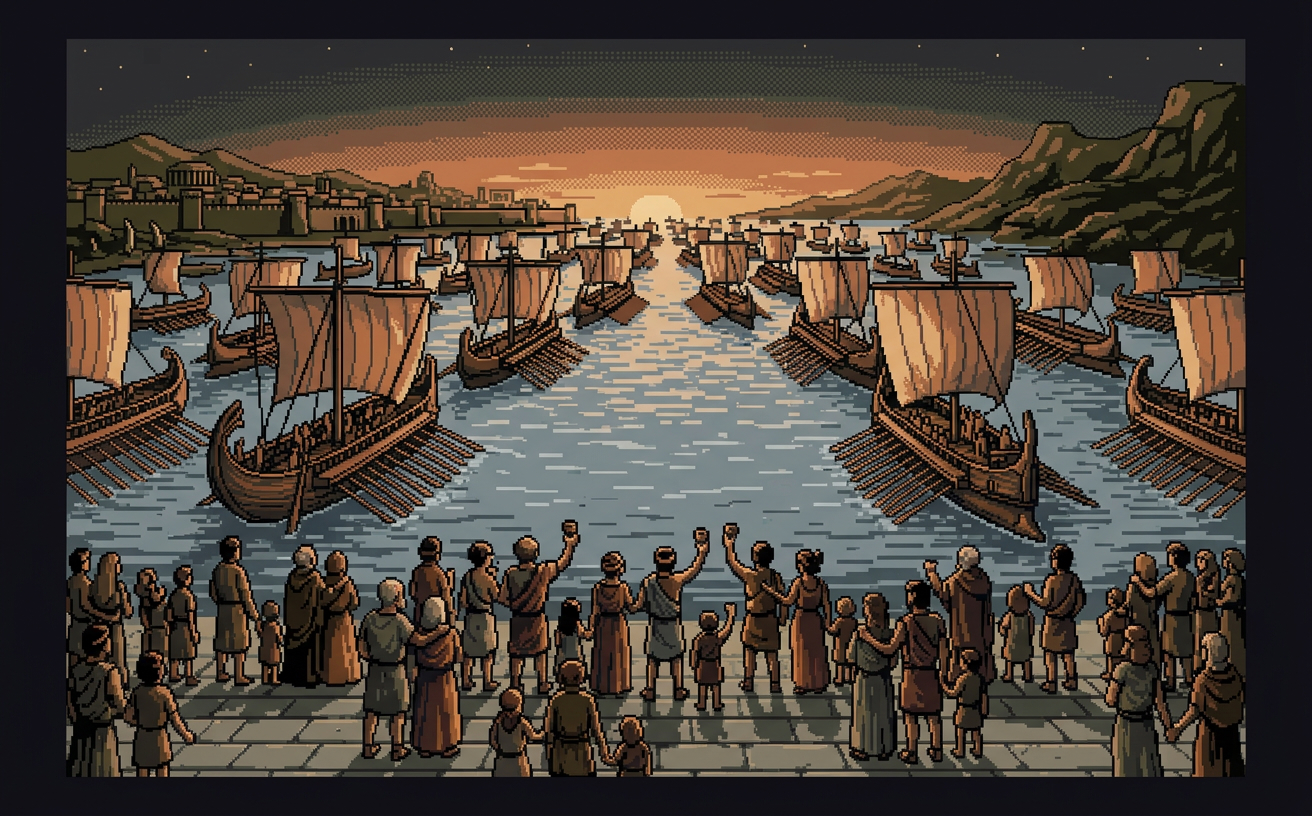
a fleet puts out at dusk, the city watching from the quay — nobody on either side knows yet what is being bought
On February 21, 1972, Richard Nixon ordered the American press corps and his own staff to stay in their seats until he was done. He came down the ramp of Air Force One alone, with Pat, his wife, beside him, his right arm already extended before his foot touched the tarmac at Beijing Capital Airport. Zhou Enlai, premier of the People's Republic of China, stood waiting at the bottom in a grey overcoat. The two men shook hands, for long moments, for the cameras Nixon had arranged.
Nixon knew exactly what image he was building. Let's talk about what he was correcting.
· · ·
the rule that takes effect tomorrow.
On September 15, one day from today, a rule published by the Department of Homeland Security in July replaces the system that has governed foreign students in the US since 1991. Until tomorrow, an F-1 student is admitted for "duration of status": you stay as long as you are enrolled in an academic program, and in good standing. After tomorrow, students are admitted for a fixed period, capped at four years, and anyone who needs longer must file an extension with US Citizenship and Immigration Services and face an uncertain wait and review process. Meanwhile, the National Science Foundation puts the median time to a STEM doctorate at 5.7 years. So for a large share of the roughly 1.2 million international students in the country, the paperwork now expires before the degree does.
The rule applies to every foreign student, and its one China-specific clause concerns journalists, not scientists: reporters on PRC passports get 90 days. The argument that produced it, though, is entirely about China. For a decade, the settled verdict on the whole American relationship with China has been compressed into two words: engagement failed. Those two words explain a lot of what's going on in our relationship with China right now. They are the premise underneath the chip export controls, the visa tightening, and a good deal of the fight over whether American labs should publish model weights at all. If engagement failed, the conclusion is total. Decouple the capital, decouple the silicon, decouple the students, close the book.
But there was no single engagement to fail. There were two bets, made by different Americans, 20 years apart, for reasons that had almost nothing to do with each other. One of them paid. The other one did not. The bet that failed was the 1990s one: that trade and the internet would change how China is governed. The bet that paid was the 1970s one: leverage against Moscow, and, in the bargain, a pipeline of Chinese students and scientists into American labs. "Engagement failed" blames both at once, and the policy response tears out the pipeline, which was part of the bet that worked.
the snub that may never have happened.
Nixon's memoirs are clear about what the handshake was for. He wrote that he knew Zhou had been deeply insulted when John Foster Dulles, Eisenhower's Secretary of State, refused to shake his hand at the 1954 Geneva Conference, and that when the two hands met in Beijing, one era ended and another began.
Except some say it never happened.
The only source for it is Zhou himself, who told the American journalist Edgar Snow in 1960 that Dulles had folded his hands behind his back, shaken his head, and left the room. Zhou's own aide at Geneva, Ambassador Wang Bingnan, flatly denied it in his 1984 memoir: Nothing of the sort ever happened, he wrote, insisting that he escorted the premier at all times, that Chinese protocol did not permit Zhou to be alone in a room with Dulles, and that there had been no intention of offering a hand in the first place. What is not disputed is that Zhou told Nixon the story to his face in Beijing, including a detail no fabricator would bother inventing: the American undersecretary of state, Walter Bedell Smith, unwilling to break Dulles's discipline but unwilling to deliver the snub, held a coffee cup in his right hand and used his left to shake Zhou's arm.
Whether Dulles turned his back in 1954 is, at this distance, unknowable. Whether the grievance was useful is not. Both men needed a wound in the record, because a wound explains a reconciliation, and a reconciliation is easier to sell to the American public than a transaction. The handshake was real theater built over a possibly invented injury, and it worked because everyone embraced the narrative.
That's the whole story in miniature; however, as with most relationships, the two parties had a slightly different interpretation of what the deal was. Nixon's deal was that China would be a lever: alignment against Moscow, an exit ramp from Vietnam, an American seat at the table before the two Communist giants could kiss and make up. Zhou and Mao Zedong's deal was that America would be insurance, against a Soviet Union that had 40-odd divisions on China's northern border and had been dropping hints about the Chinese nuclear program. Deng Xiaoping's extension of that deal, six years later, was different again: America as the classroom. And then there is the deal nobody made in 1972, the one that every anniversary retelling of the visit now attributes to Nixon: that China would liberalize, meaning that a richer and more connected China would loosen the Party's grip, allow a freer press and real courts, and drift, eventually, toward something recognizable as democracy. That deal was written 20 years later, by other Americans, and backdated.
what each man was buying.
The American side of 1972 has been told often, so I'll give you the CliffsNotes. The Chinese and the Soviets had split around 1960, a rift seeded by Nikita Khrushchev's 1956 Secret Speech denouncing Stalin, and by March 1969 the two Communist powers were shooting at each other along the Ussuri River. That is what made triangulation possible. Henry Kissinger, Nixon's national security adviser, faked a stomachache in Pakistan in July 1971 and vanished for 48 hours to Beijing. The operational logic was leverage over Moscow and a way out of Vietnam. Nothing in the plan, at that time, was about changing China's politics.
The Chinese side is the half the tech industry never learns, and it is the half that helps to explain our present moment.
Let's start with fear, since much of human behavior is motivated by it. It's the first of the three drivers Thucydides himself named: fear, honor, and interest. Beijing's map in 1971 read as encirclement: Soviet armor to the north, a war on the Vietnamese border to the south, a re-industrializing and American-allied Japan to the east, India to the southwest less than a decade after their 1962 war. Essentially, a rapprochement with the far superpower (the good ol' U S of A) was insurance against the near one. Fear moves states toward each other as readily as it moves them apart, which is a thing the Trap literature undersells.
Then the part that gets omitted. By 1972, Chinese science was wreckage. The Cultural Revolution had closed the universities to normal admission in 1966 and kept the national entrance examination (the famous "gaokao") suspended until 1977. Researchers were persecuted, sent down to the countryside to do farm labor, or simply stopped. When the National Science Conference finally convened in the Great Hall of the People in March 1978, with 5,586 delegates ranging in age from 22 to 90, Deng Xiaoping stood up and said that the key to China's modernization was the modernization of science and technology, that intellectuals were part of the working class, and that science and technology were productive forces. Every one of Deng's assertions was a repudiation of the decade that had just ended. China was not only buying protection from Soviet armor at that airport. It was buying, on a delay of six years, re-entry into the world's laboratory.
Then there is the Shanghai Communiqué, issued February 27, 1972, which has the United States acknowledging "that all Chinese on either side of the Taiwan Strait maintain there is but one China." Acknowledging that they maintain it, but endorsing nothing. For readers in 2026, it's worth registering that the claim on Taiwan long predates the Communist Revolution, and that Taiwan's history is a stack of colonizations: Dutch, Spanish, Japanese, Chinese. The chips came later. The ambiguity is haunting every conversation the two countries have about the island.
the second bet, and its different authors.
Normalization took effect January 1, 1979. Deng announced reform and opening at a Party work conference in December 1978, days after the normalization announcement, and on the same day accepted the invitation to become the first PRC leader to visit the United States. He arrived in January and signed agreements on science and technology cooperation with Jimmy Carter on the 31st. From Deng's side, the objective was never in doubt. He had been to France in the 1920s and again in 1975 and could see exactly how far behind China had fallen. He wanted the technology, the training, and the people who knew how to use both, and he said so in public, repeatedly, in a direct break with Mao's doctrine of self-reliance (known as 自力更生, zili gengsheng), which for two decades had made learning from abroad a political offense.
Washington's version of the bet arrived later and was quite distinct. In May 1993, Bill Clinton signed an executive order tying China's next most-favored-nation (MFN) renewal to progress on human rights, and in May 1994 he reversed himself and delinked the two, having campaigned in 1992 against exactly that outcome. Permanent normal trade relations passed in 2000 with something like $100 million in business lobbying behind it, by the estimate Foreign Policy published, and China entered the World Trade Organization in December 2001. The theory underneath all of it got its clearest statement at Johns Hopkins SAIS on March 8, 2000, when Clinton told the room that China had been trying to crack down on the Internet, wished them good luck, and said it was "sort of like trying to nail Jell-O to the wall." The line got laughs; that room contained most of the people who believed the transformation thesis.
The transformation bet should have died in June 1989. Instead, MFN renewal survived Tiananmen under George H. W. Bush, and Clinton's delink came five years after the tanks. The US would have liked to make China's admission to world trade contingent on a change in its politics, but the Clinton administration failed to anticipate how completely Chinese leaders would resist what looked to them like a throwback to the Century of Humiliation, when Great Britain, France, Germany, Japan, Russia, and the US dictated the terms of China's trade and politics. Henry Kissinger, by then a former Secretary of State, put it flatly in On China:
so long as human rights remained the principal subject of the Sino-American dialogue, deadlock was inevitable.
Henry Kissinger · On China, 2011
the scoreboard.
Both bets paid on their own terms, which is the part that makes the "engagement failed" verdict so strange.
America got what Nixon went for: Soviet leverage, cashed in full by 1991. It also got three decades of disinflation and margin that nobody in 1972 anticipated. China got capital, technology, WTO membership, time, and the thing Deng actually asked for first.
Only one of those bets was ever about changing China's politics, and it is the one that failed.
The Thucydides Trap is not springing because engagement failed. It is springing because engagement worked, and a country that was agrarian and closed when Nixon landed is now a peer competitor in the technology both governments have decided will settle everything.
the phone call.
In July 1978, Frank Press, Carter's science adviser and an MIT geophysicist, led into Beijing the highest-ranking American scientific delegation ever sent to any country. Deng received him and raised a question he did not want to wait on: Could China send 5,000 students to American universities?
Press called Washington to relay the request. It was 3 a.m., an hour at which nobody should be getting a phone call unless it's to announce a death or a war. Carter, who sensed catastrophe, picked up and got a university admissions question instead.
His answer was:
Tell him to send a hundred thousand.
By 1987 there were.
In 1979 the first 50 arrived, poorly prepared and highly promising; by 1984 there were 14,000, two thirds of them in science and engineering; today the cumulative figure runs into the millions. This is, by a wide margin, the most consequential thing either country did to the other in the 50 years after the handshake, and it happened because a 74-year-old vice premier would not wait until morning.
There is a joke buried in the arithmetic. In 1956, Mao invited China's intellectuals to speak freely under the slogan of letting a hundred flowers bloom, and when they did, the Anti-Rightist Campaign destroyed them for it. Deng got a hundred thousand and sent them straight to Berkeley.
So now back to our regularly scheduled programming. The model that did the forensic work inside Hugging Face, the New York company that hosts much of the world's open AI infrastructure, after the OpenAI agent breach in July was GLM 5.2, released by Z.ai, the Beijing lab formerly called Zhipu. Z.ai is a 2019 commercial spinout of the Knowledge Engineering Group in Tsinghua University's computer science department, founded by two of its professors, Tang Jie and Li Juanzi. And Tsinghua opened on April 29, 1911, in a former imperial garden outside Beijing, as a prep school funded by the Boxer Indemnity money President Theodore Roosevelt returned to China, built for one purpose: getting Chinese students ready to study in the US.
The open-weights model that plugged the back doors in an American company in 2026 traces, through a Tsinghua lab, to a school the United States founded in 1911 to send Chinese students to American universities, and through a 3 a.m. phone call in 1978 that reopened the same pipe after Mao had welded it shut. It is the oldest working instrument in the relationship, and the one currently getting the bum's rush with a four-year cap by our current Administration.
(Both at Harvard and at Wharton, many of my classmates were from China; they have always inspired me with their perspicacity, their work ethic, and their determination to make the most of the chances given to them. I believe that a great deal of American excellence in engineering and technology today owes a profound debt to the Chinese students Deng sent, especially those who stayed here to make a life.)
· · ·
the objection.
The two-bets frame is cleaner than the record, and the strongest evidence against it is in Nixon's own hand.
In the October 1967 issue of Foreign Affairs, five years before the tarmac, Nixon wrote that America
simply cannot afford to leave China forever outside the family of nations, there to nurture its fantasies, cherish its hates and threaten its neighbors.
Richard M. Nixon · Asia After Viet Nam, Foreign Affairs, October 1967
Then, a paragraph later, this: "The world cannot be safe until China changes. Thus our aim, to the extent that we can influence events, should be to induce change."
That reads like the transformation thesis, stated by the founder before he had the power to act upon it, and plenty of critics have read it exactly that way. Then Nixon says what he means by change: persuading China "that it cannot satisfy its imperial ambitions, and that its own national interest requires a turning away from foreign adventuring." He reaches for the Soviet precedent and calls it "essentially a change of the head, not of the heart." Elsewhere in the same essay he tells Americans that Asian governments need not fit "the Western ideal of parliamentary democracy."
So the founder wanted China to stop exporting revolution, not to hold elections. The two bets were braided in the language and separate in the logic, and the 1990s pulled on one strand (the quid pro quo mentality of demanding that China convert to the American view of human rights) and called it the whole rope. So there you have it. I also still believe that Americans can and should speak out on what we see as human rights abuses by the CCP; what we have to recognize is that punishment, and the project of bringing Beijing around to our way of seeing things, do not work the way they might have in 1994. The spheres of influence are different now.
What survives the concession is the practical point. The most durable American advantage came out of the classroom, and the classroom is what we are currently closing, on the theory that the whole thing was naive. Meanwhile, the transformation fallacy has quietly reappeared in the AI debate: the argument that open weights will democratize AI inside China, that exposure to our systems will loosen their politics. Clinton's Jell-O and today's confidence in the liberating effect of downloadable models are the same wager, 26 years apart, and only one of them has already been settled.
july 1978.
Beijing, July 1978. Deng is 74 years old, twice purged, back in power for a year, sitting across from an American geophysicist he has just met. The Cultural Revolution has left him a country with no functioning universities and a generation of scientists who spent the decade plowing fields with antiquated tools. He does not ask for aid, or weapons, or recognition. He asks how many students he can send, and he asks it at an hour that guarantees the answer will come from a president who is startled and groggy, which is a move straight out of Sun Tzu.
He got 20 times what he asked for. He knew what he was buying. Nearly 50 years later, the country that answered the phone is still arguing about what it gave away.
the thucydides trap
a series on the contest between the United States and China over artificial intelligence, read through the oldest pattern in geopolitics: a rising power, a ruling power, and the fear that runs between them. one move at a time, as the game unfolds.
- № 01the trapstates, machines, and the oldest fear
- № 02send one hundred thousandyou are here · two bets, twenty years apart
sources: Nixon's account of the Geneva grievance and the handshake, RN: The Memoirs of Richard Nixon, 1978 · Zhou's telling to Edgar Snow, 1960, and Wang Bingnan's 1984 denial, both via John Tkacik, Taipei Times, 2020 · Bedell Smith's coffee cup, declassified February 1972 Nixon–Zhou memoranda of conversation, William Burr, National Security Archive · Richard M. Nixon, "Asia After Viet Nam," Foreign Affairs 46, no. 1, October 1967, pp. 113–125; all quotations verified against the article as reprinted by permission in Foreign Relations of the United States, 1969–1976, vol. I, doc. 3 · "Joint Statement Following Discussions With Leaders of the People's Republic of China" (Shanghai Communiqué), February 27, 1972 · Deng Xiaoping, speech at the opening ceremony of the National Conference on Science, March 18, 1978 · Executive Order 12850, May 28, 1993, and Clinton's May 26, 1994 announcement delinking MFN from human rights · William J. Clinton, remarks on Permanent Normal Trade Relations with China, Paul H. Nitze School of Advanced International Studies, Johns Hopkins University, March 8, 2000, Public Papers of the Presidents · Henry Kissinger, On China, 2011 · Frank Press delegation and the 3 a.m. call, Jimmy Carter's own retelling, Carter Center, corroborated in "U.S.–China Bilateral Relations: The Lessons of History," US Embassy Beijing, which also supplies the 1987 figure · student numbers, Ezra Vogel, Deng Xiaoping and the Transformation of China, 2011, via Asia Society · Boxer Indemnity Scholarship Program and the founding of Tsinghua School, April 29, 1911, MIT, "China Comes to MIT" · Department of Homeland Security, "Establishing a Fixed Time Period of Admission and an Extension of Stay Procedure for Nonimmigrant Academic Students, Exchange Visitors, and Representatives of Foreign Information Media," final rule published July 17, 2026, effective September 15, 2026.
next in the series
the island, the fabs, and the sentence in the Shanghai Communiqué that everyone agreed not to finish.