the missing on-ramp: what we lose when AI takes the first job
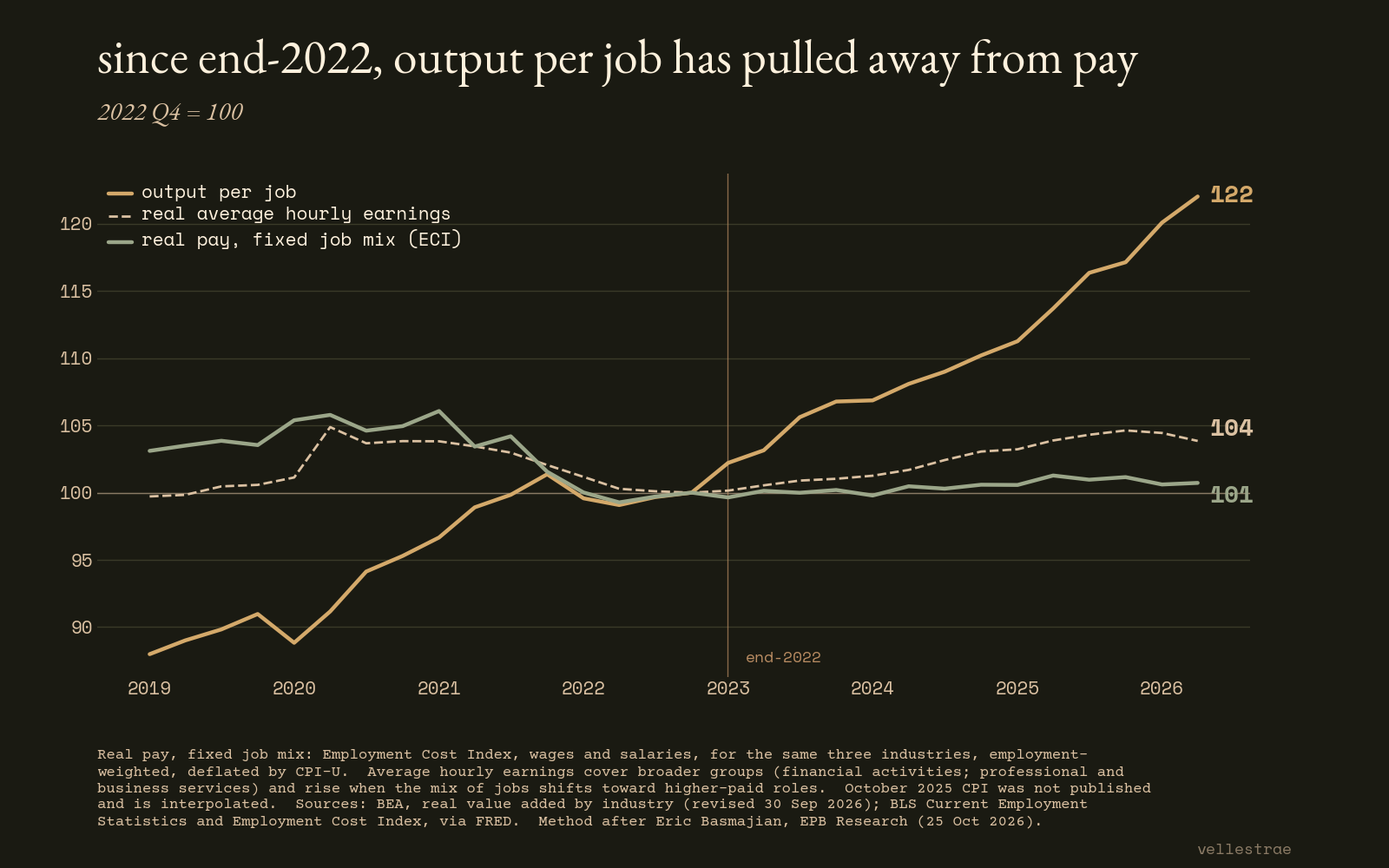
Output per job in the three heaviest AI-adopting industries is up 22% since the end of 2022, while pay for the same jobs has barely moved. What AI is taking first isn’t jobs but apprenticeships, the on-ramp where beginners become experts. The Luddites of Nottingham lost that same fight in 1811, and the repair took decades.
what is "ergon"?
In Greek, "ergon" means work, function, or deed. In the Nicomachean Ethics, Aristotle argued that to understand what makes a thing good, you have to understand its ergon, or function. For a flute player, a sculptor, or any artisan, he wrote, the good lies in the work itself: a flute player is good when he plays the flute well. But Aristotle also extended the metaphor more generally to humans as a species: could humans, overall, have a function proper to them?
According to Aristotle, we do. The ‘ergon’ of a human is rational activity, the use of our reasoning, and the human good is doing that well, with excellence.
So what happens to human thinking, human work, and ultimately human purpose, when AI can out-think, out-code, out-math, and out-philosophize us?
A DeepMind essay published on October 29th by Stephanie Chan, Julian Jacobs, and Logan Cross, asks a version of Aristotle's question with modern data: what is work for, beyond the paycheck? Their answer is hopeful about the Future of Work. In surveys across the UK, the US, Denmark, and India, people rank their work about as highly as their country and their hobbies, just below family. About a fifth of workers in the US, UK, and Denmark say they would not leave their job, even for a guaranteed income of 100% to 120% of their salary. Most lottery winners keep working, even after multi-million-dollar payouts; they use the money to buy flexibility, not to quit. Losing a job damages wellbeing for years, while retiring by choice does not. And people judge an activity to be meaningful partly by how challenging it is: in one experiment with AI writing tools, the people who felt they had put in less effort rated their work as less meaningful.
What work gives people, in other words, is, in many ways, a vehicle for their ‘ergon:’ the use of their gifts, done well, among others who can see and appraise it. Social connection, meaning, a sense of contributing. A paycheck can approximate some of that, but it doesn't fully replace it. Which makes the economics of the next few years both a question of wages, and of human purpose.
My belief is that we are not yet in an AI-fueled Jobspocalypse. What AI appears to be taking, though, is apprenticeships: the years in which a beginner becomes adept at something. The evidence, from Nottingham in 1811 to payroll data in 2026, says that that is the expensive part. When the ladder to expertise breaks, a generation pays, the people who own the machines collect, and the market takes decades to repair the damage on its own.
the Luddites of Nottingham would have hated data centers, too.
You’ve probably heard the expression "I'm a Luddite," meaning the person doesn't like technology, etc. But the Luddites were a real movement in 19th Century England, and they were not against machines as such. In 1811, the frame-breakers of Nottinghamshire worked stocking frames for a living. What they objected to, in the letters they signed "Ned Ludd," were two practices. The first was "cut-ups": cheap stockings sewn from cut cloth rather than knitted whole, run off on wide frames, which damaged the trade's reputation. The second was "colts," workers who had not served the seven-year apprenticeship required by law. Wide frames could be worked by less-skilled hands, which meant a master could hire “colts” (someone without proper training) at lower wages than a journeyman's. The law the Luddites invoked was the Statute of Artificers, from 1563, which made it an offence to practise many trades without serving an apprenticeship.
There were several different groups of tradesmen throughout England protesting this use of new technologies to essentially hire unskilled labor at a lower wage, and several tried legal routes before things turned violent.
Parliament brought a Frame-Breaking Bill, which made destroying a stocking frame a capital crime, and it passed the Commons in February 1812. The poet Lord Byron, a young peer in the House of Lords, wrote to his friend Lord Holland that he feared Holland would think him "half a frame-breaker myself" (his sympathies were with the machine-breakers), and two days later gave his maiden speech against the bill. Parliament passed it anyway. Two years after that, in 1814, Parliament repealed the apprenticeship clauses of the Statute of Artificers (which protected tradesmen who had gone through an apprenticeship). The masters were now free to hire unapprenticed workers to run the new frames.
So who gained, and who suffered? The economic historian Professor Robert Allen (then at Oxford, now at NYU Abu Dhabi) worked out the numbers in a 2007 paper he called "Engels' Pause," after the young Friedrich Engels, whose 1845 book on the English working class described the result. Between 1780 and 1840, output per worker in Britain rose 46%. During those same 60 years, the real wage, meaning what that pay could actually buy, rose only 12%. At the heart of the pause, from 1800 to 1830, the famous inventions of the Industrial Revolution pushed output per worker up 0.63% a year, while the real wage stayed flat. Labor's share of national income fell from about 60% to about half. Capital's share more than doubled, from 20% to over 40%, and the rate of profit rose from near 10% to over 20%. The owners of the mills and frames were winning. Workers and landowners were bearing the brunt.
The upshot? In Allen's account, the profits financed the next generation of machines, mills, and railways. Investment rose from about 6% of GDP in 1760 to 11% in the 1830s and 1840s, with jumps he links, in a footnote, probably to canal mania and railway building. Once the stock of capital caught up with the technology, wages then began to move with productivity: from 1840 to 1900, output per worker rose 90% and the real wage 123%.
So ultimately, the Luddites didn’t lose the argument about machines. They lost the argument about who gets paid, and the answer took decades to arrive (which is a long time, especially if you're the worker or the family caught up in the change). What they were defending was the ladder, or what I call the “on-ramp”: the seven years by which a beginner became a journeyman, and an artisan learned the ‘ergon’ of his trade. The new machine let masters skip that ladder from the top, hiring unskilled novices. That’s the part that matters for us, in 2026. The question is no longer whether the machine can do the work, but whether anyone is still being trained to excel in the judgment calls that make human expertise worth paying for.
is this time different?
This is a good time to check in with people who know about technological shifts, and few people know more about that than Bill Gates. So is AI just another new technology, like the personal computer or the internet? In an August essay on his site, Gates Notes, Gates argues that "This time really is different," and that analogies to past innovations are misleading, because the move from farm to office took generations and the AI transition will take about a decade. I believe it might take even less time than that. Gates also points out that, with earlier technologies, people had to adapt to the tools; AI runs on the devices we already have, takes instructions in plain language, and, in his words, "can adapt to us." I'd add that it will only get better at doing so. He writes that the jobs most at risk are entry- and mid-level, and that he is especially worried about young people entering a workforce with fewer entry-level openings.
Gates’ proposal, which I’ve covered before, is a category he calls “Human Reserved:” work set aside for people by public decision, on the model of a nature preserve. His example is personal. His father was cared for through Alzheimer's by paid caregivers, and Gates writes that no robot could or should have done that work. He would pay for it, he says, by taxing AI tokens and robots. (He also flags his own bias: his ties to Microsoft, and his foundation's partnerships with the AI labs, including the ones that make Claude and ChatGPT.)
Gates's worry has a precedent from 1821. David Ricardo, one of the leading economists of the Luddites' decade, first held that machinery benefited everyone, then added a chapter to the third edition of his Principles admitting that it was "often very injurious to the interests of the class of labourers." His worked example was stockings, which refers us back to our friends the Luddites. Ricardo saw the first half of the story, the pause; he didn't live to see it end. Whether this “time is different” is something the data can begin to test, and the real test is whether the on-ramp, the training wheels that let people develop expertise, is disappearing.
three charts that disagree with each other.
On October 25th, Eric Basmajian, the analyst behind the research firm EPB Research, posted a chart showing that output per payroll job in the three industries adopting AI most heavily (information, finance and insurance, and professional, scientific, and technical services) had grown 2.2% a year from 2005 through 2022 and 5.0% a year since. The rest of the economy sped up far less, from 0.9% to 1.4% a year. Six days later, in the Financial Times, the data journalist John Burn-Murdoch performed surgery on that claim. Extend the finding to other rich countries and it vanishes; narrow it from whole industries to occupations, and it becomes a story about software jobs, rather than finance or professional services. The break comes in 2022, when AI meant chatbots rather than agents, and a ratio of output to jobs rises whenever jobs fall, whether or not output moves. His alternative explanation was rate hikes and Big Tech layoffs that predate anything you could call production-ready AI.
Both of them were working from the same public data, so I tinkered with it myself. The Bureau of Economic Analysis (BEA) publishes real output by industry; the Bureau of Labor Statistics (BLS) publishes payroll jobs. Divide one by the other for those three industries, and Basmajian's line comes back almost exactly: an index of 180 in the second quarter of 2026 against his 179, an old trend of 2.25% a year against his 2.2%, and a pace since the end of 2022 of 5.4% against his 5.0%. The method holds.

Then the split, which is what Burn-Murdoch was asking for. From the end of 2022 to mid-2026, real output in the three industries rose 20.8%. Payroll jobs fell 1.0%. The productivity line is mostly an output line, and output growth sped up, from a 3.4% annual trend to about 5.6%. His headcount story is true in exactly one place: information, where jobs fell 10.5% while output rose 35%. In finance and professional services, headcount barely moved, and Burn-Murdoch himself offers the reason: personal relationships still matter in those industries in a way that they don't in software.

The third chart raises more questions. Average hourly earnings in these industries rose about 4% after inflation over the same period, which looks like workers sharing in the gains. But the Employment Cost Index, which tracks pay for the same set of jobs every quarter instead of averaging over whoever happens to be employed, rose less than 1% after inflation through mid-2026: about 0.2% a year, slower than its 0.4% trend before 2023, and still 2.7% below where it stood at the end of 2019. The newest reading, for the third quarter, released on October 30th, is weaker still: real pay for the same jobs is up about 0.4% since the end of 2022, and 3.1% below the end of 2019. The gap between the two pay lines most likely reflects a change in who is employed rather than raises, consistent with the cheaper, more junior jobs thinning out and lifting the average. Set beside output per job through mid-2026, the picture is 122 against 101.
So who's losing out? This is the chart the thesis rests on. The Stanford Digital Economy Lab, working with payroll data from ADP, published a revision of its "Canaries in the Coal Mine" study in August, with data through June. Workers aged 22 to 25 in the occupations most exposed to AI are now about 19% below where they would be, had they kept pace with peers in less-exposed jobs; a year earlier the gap was 15%. In plain counts, their employment fell about 11% from November 2022 to June 2026, while young workers in the least-exposed jobs grew about 10%. The adjustment runs mainly through hiring rather than firing, and shows up in employment rather than base pay, which fits what the Employment Cost Index suggests. The finding is complicated, though, because another study finds the junior-hiring effect fades once remote work is accounted for, since remote work makes beginners expensive to supervise, and the Stanford authors reran that test and found the opposite. Census Bureau researchers tracking 6.7 million graduates found the same shape: graduates of the most AI-exposed majors were five points less likely to be employed and earned about 13% less at the start, roughly what graduating into a recession costs, with about half the loss coming from graduates starting out in lower-paying industries, such as retail and restaurants. The picture is also moving fast. In June, on the Dwarkesh Patel podcast, the economist Alex Imas said you "really have to squint" to see any AI effect in the labor data, with junior developers only "a bit below trend." By August, Stanford had the gap at 19%, and by October Imas's own DeepMind essay was predicting softer entry-level hiring in the roles closest to the tasks models are tested on.

Three caveats to bear in mind. Output is adjusted for inflation with industry prices and pay with consumer prices, a choice that economists debate. (Allen made a similar choice for Britain.) The gap opened before ChatGPT: output per job in these more AI-exposed industries rose about 14% from 2019 to 2022, while real pay slipped about 3%, which supports Burn-Murdoch on timing. And part of the output gain is the AI build-out itself. The BEA category for data processing and hosting is where cloud computing lives: Amazon Web Services, Microsoft Azure, and Google Cloud, the companies renting out the computing power AI runs on (these are the “picks and shovels” of the AI gold rush). It rose 68% in real terms, and together with publishing (which includes software: Microsoft, Adobe, Oracle, and the rest), it accounts for a large share of the three industries' output gain. Some of what we are calling productivity is the picks-and-shovels business itself. Economy-wide, the effect is still hard to attribute to AI. Daron Acemoglu, the MIT economist who shared the 2024 Nobel Prize, said on the Silicon Valley Girl podcast in October that AI is not yet having the productivity effects people expected, and that, by Acemoglu's account, Erik Brynjolfsson, the Stanford economist behind the Canaries study, agrees it hasn't arrived yet. Where it does show up, as in these three industries, the build-out is inside the number.
the economists' version.
On October 29th, Google DeepMind published a long essay on how and when AI transforms an economy, written by Alex Imas (an economist at the University of Chicago and DeepMind's director of AGI economics), Andrew Koh (an economist at Columbia), and Shane Legg (DeepMind's co-founder). Their argument separates two things that usually get intermingled. Competence is how good an AI system is at a task. Coordination is how well many of them work together. Competence sets how much one worker, human or machine, can produce; coordination sets how big an organization can get before it becomes unwieldy. Today's models are very competent but coordinate poorly, and the essay's own witness for that is Noam Brown of OpenAI, who told Dwarkesh Patel in September that he would not credit even a tenth of his team's recent result to agents working together, and that ten thousand humans may still coordinate better than ten thousand agents. We can put that down as a point for the humans.
On that reading, we may be in the first of four stages the authors sketch, the one they call minimal AGI, and its signature is that "wage effects arrive before organizational restructuring." Pay for the jobs a model can match drifts toward what it costs to run the model instead, and I expect that cost to keep falling as cheap open models, many of them from Chinese labs, compete on price. Meanwhile specialists, managers, and the people who direct complex work earn more. Firms get leaner and flatter, and the gap is in entry-level hiring in the roles closest to the tasks that the models are tested on.
Set against the three charts, the fit is close: pay for a given job flat, averages lifted as the cheaper jobs thin out, the youngest workers absorbing the adjustment. But a close fit is not proof. The same data could also be explained by the 2022 rate hikes, or by the shift to remote work, without AI doing much at all. So the most the evidence allows us to say is that it matches what the DeepMind theory predicts: flat pay for the jobs a model can match, higher pay for the people who direct the work, and fewer beginners hired. It doesn't confirm the theory, and nothing in it yet shows pay actually falling toward the cost of compute.
The “on ramp” has economists behind it now. Luis Garicano and Luis Rayo have a formal model of when apprenticeship stays viable as AI takes over the tasks below a rising threshold of expertise. And the Stanford study's newest finding is that the young workers losing ground are in jobs built on codified knowledge, the kind you can write down in a manual (standard code, tax rules, routine legal research), while experienced workers in jobs built on tacit knowledge, the kind you learn only through experience and interaction, are gaining. Consider a surgeon's feel for tissue, a teacher's confidence that a student grasps a concept, a realtor's sense for which house a person will buy, or a senior lawyer's instinct for which argument a judge will buy. That distinction has a name, Polanyi's paradox, after the philosopher Michael Polanyi: we can know more than we can tell. The colt the Luddites fought in 1811 was a beginner who skipped the years that honed that job-specific sixth sense. The 22-year-old of 2026 risks being a beginner who never gets the chance to develop it, if AI does the beginner's work more cheaply. (One disclosure: the Stanford split between jobs where AI automates and jobs where it assists rests on the Economic Index published by Anthropic, the company that makes Claude, which I use in my work.)
One interesting point: Gates and the DeepMind economists disagree about whether history applies to our AI moment, but they arrive at the same place. Gates would reserve ‘human work’ by policy, meaning that the government must get involved to address the gaps. Imas expects it to survive by preference, in what he calls the "relational sector": care, teaching, hospitality, craft, and the small human services where the person is part of the experience or the value of the good. These are the parts of life built around shared human experience, like the need to learn, or the experience of being ill or growing old. Both Gates and Imas end with people providing the value that only a human can. My guess is we'll need both: Imas's market for the human part, and Gates's rules to keep the on-ramp going.
the other side: will consumers want ‘cheaper’ or ‘human-made’?
On the Dwarkesh episode with Alex Imas, Phil Trammell's answer to all of that is a thought experiment. Picture an economist in Mongolia around 1400, asked to predict how people would spend in a vastly richer future. Holding the range of goods fixed, he would predict that people would soon have all the horses, yogurt, and tents they wanted and spend everything else on singers. That is to say, they would be satiated with the set of goods that were available at that time and spend their extra cash on art and entertainment. Instead, wealth kept inventing new things to buy, and the share spent on singers stayed negligible. (In the comments under Imas's essay, Trammell made the same point about the Middle Ages: we are hundreds of times richer and spend almost nothing on live performers.) That, he says, is his central prediction for how the AI future unfolds, though he grants it could go either way. Which is an uncomfortable point if you happen to be a ballerina or a singer.
Imas's reply is that performers are "a red herring," the wrong reference class, and he reaches for a doctor instead. A doctor's job, he points out, is mostly insurance forms and phone calls to pharmaceutical companies; seeing the patient is one task among many. Automate everything except the moment the doctor delivers the diagnosis and provides support, and if patients will pay more to keep that moment human, the job belongs to what he calls the relational sector. That sector, in his view, is most of the service economy: jobs that bundle human tasks with routine ones, where AI strips out the routine duties and the human part becomes the product. His evidence is an experiment, run with Graelin Mandel at Chicago Booth, in which people bid real money on prints described as human-made or AI-generated. The human-made print commanded a premium, but the premium fell sharply when buyers were told 500 copies existed, because, in Imas's words, it was no longer seen as making a connection with one artist. The AI print gained far less from being scarce; AI, he says, is already viewed as a commodity.
Imas opens his essay with a real-world case, and it holds up in the company's own words. On its April 2025 earnings call, Brian Niccol, Starbucks’ CEO, told analysts that over the previous couple of years the company had removed labor from its stores on the assumption that equipment could make up for it, and that the assumption had not held up: the equipment alone did not deliver the customer experience; staffing, with the right technology behind it, did. Starbucks paused the rollout of its expensive new store equipment, put the hours back behind the counter, and brought back handwritten notes on cups, ceramic mugs, and comfortable seats. Eighteen months later, on October 29th, it reported global comparable sales up 7.2% and U.S. comparable sales up 7.7%, with transactions rising, and Niccol called the turnaround plan a growth plan. The recovery had other causes too (higher prices, more food in the order, and hundreds of store closures), so the people are part of the story rather than all of it. But a large company bet on machines over people, reversed the bet, and its comparable sales are growing again. The barista's craft, it seems, is part of the product.
And Imas concedes two things: that nobody has definitive answers yet, and that if new machine-made goods keep arriving faster than people shift their spending toward human services, nearly all the growth in spending goes to machine-made things. Human work keeps a smaller and smaller slice of a growing pie, and over a long enough horizon, labor's share of income heads toward zero. The relational sector only saves us if people move our money into it faster than machines can invent new things to sell us. Imas also stresses how little we know. We don't have data, he says, on how much people would pay to keep a human “in the loop,” rather than accept a fully automated version of a service. On therapy, he lays out the argument that people will come to see an AI therapist as the better product, and his reason for doubting it: people who insist on dealing with other humans may be the ones more likely to find partners and have children, which could strengthen the preference over time. He calls it a really complicated question and isn’t making a call yet.
Both economists agree new goods will keep coming. They disagree about how much of today's work is already relational: Phil Trammell sees very little of it, whereas Alex Imas counts a large share of services. The Stanford data leans Imas's way, since the part of the work that seems to be holding up is the tacit part, the one employers can't discount or disregard, and so does Burn-Murdoch's explanation that finance and professional services shed far fewer people than software, because trust and relationships matter significantly there. Bottom line? Where human work survives, it is the trained, tacit part, and that is exactly the part the “apprenticeship” or the “on-ramp” exists to produce. But that’s exactly what AI is chipping away at right now.
Trammell's point is the Luddite story, told in reverse. The handloom weavers were artisans whose human-made product lost to a cheap machine-made one, and in mass markets, that has mostly been the pattern. For 20 years I have coached the professionals that the DeepMind essay calls coordinators/managers: the ones who may not be the best at any single task but excel at leading and coordinating the best performers in their lanes (i.e., middle management). So I know both ends of this argument from the inside, and here is the question I'd put to both economists: How will people afford the relational economy, when most of them live on wages? A reader asked it in a single line under Imas's essay. The third chart is where that question lives. If pay for a given job stays flat while output races ahead, the income that would fill the theater is going somewhere else. In 1811, it went to the owners of the frames, the tech founders of their day.
follow the wage test.
The wage test, rather than the productivity chart, is the one to watch, and it already shows the signature Allen found: output per worker pulling away from pay for the same work. The comparison needs a caveat on scale. Allen measured the whole British economy over 60 years; the three industries I looked at are one slice of the American economy, measured over 3.5 years. But the shape is the same, and the precedent fits the gap. What it doesn't fit is who bears the burden. Allen's pause fell on nearly every worker's wage. This one, so far, is falling on the youngest: people in their early twenties starting out in the jobs AI can most easily do, many of them college graduates, rather than unskilled workers. That’s the difference between 1811 and 2026, and it’s a crucial one. In the 1800s, the machine let masters skip the on-ramp from the top, hiring untrained hands. In the AI age, it lets firms skip the on-ramp from the bottom, hiring fewer beginners. Either way, the path to expertise is what’s being cut. And that matters a lot if you are young, college-educated, and looking for work, or if you’re a parent trying to advise your kid in a job market that is getting revamped by AI.
The best case against this piece also comes from Imas, and it deserves a straight answer. Think of a job as ten tasks. If AI automates nine of them and the person concentrates on the tenth, the service gets cheaper, and if demand for it grows enough, firms hire more people, not fewer. On that reading, AI could widen the on-ramp: beginners who can do the human part from day one, with the machine doing the rest. It's the hopeful version, and it has happened before. So far, the data don't show it. If firms were hiring more beginners to do the human tenth, the youngest workers in the most exposed jobs would be gaining ground, and instead they are 11% down while their peers are 10% up. Pay for the same jobs has not budged. And nothing in the data shows the output gains flowing to wages or to training. The hopeful version may still arrive. Until hiring of beginners turns up, the on-ramp argument stands.
My thoughts: Imas is right about where human work survives: in the tacit, relational part of a job, the part a surgeon, a teacher, a banker, or a ballerina learns only by doing it for years under the guidance of master practitioners (to wit, at the end of ballet class, we students always say, “Thank you, Maestro!”). Gates is right that the market won't get us there on its own in time: Allen's numbers say the last repair took decades. The gap between them is the “on-ramp.” Few firms have a reason to pay for it, because skipping it is cheaper, exactly as it was for the Nottingham masters. AI may well create good human work. The harder question is who will prepare novices to do that work to a high standard, and who pays for the years in between. In 1811 the answer was the law, until Parliament repealed it. My answer is that government should make the beneficiaries pay, as Gates's token tax would: in 1811 that would have meant the owners of the frames, and today it means the industries whose output per worker rose 22% while hiring of young workers in exposed jobs fell.
There is support for this view. Daron Acemoglu, who has studied who gained from robots, from early 20th-century technology, and from the Industrial Revolution itself, told Silicon Valley Girl that he is not against automation, only against automation as the only thing we do, because that path eliminates jobs "without creating meaningful high-paying high productivity jobs." His arithmetic for a business owner is blunt: automate 5% of your jobs and halve their cost, or make all your workers 5% more productive, and the latter option pays more. He rejects what he calls “inevitabilism”: the belief, common in the AI industry, that the path it’s on is the only one. Technologies like electricity and the printing press, he points out, were developed in many different ways, and the choices weren’t neutral. Each brought different benefits and costs, to different people. And he puts the asset exactly where the on-ramp lives. Much of the tacit knowledge, he said, is with the workers (who put in the hours and developed the expertise).
Two fears the evidence supports: a thinner on-ramp into skilled work, and pay that doesn't keep up with productivity. Two it doesn't support yet: mass displacement, and falling pay for people already employed. Population-wide data from Finland and Norway find little effect on young workers so far (though a gap began to open in Norway in 2025), so the thinner on-ramp may be largely an American story for now. But I am in America, so I, too, am worried about the diminished on-ramp, and the pay that lags behind productivity.
Which brings me back to Chan, Jacobs, and Cross. Losing the on-ramp is not only about a loss of wages. A group of mathematicians recently complained, in an open letter, that AI-generated proofs deliver the right answer while skipping the process by which a mathematician learns to think, and the collaboration and friction of debating ideas with peers. That's the Luddite argument, again, in a different trade. The apprenticeship years are where competence, recognition, identity, and professional relationships get built, along with expertise. Money is part of why we choose our work, but there's always something deeper at play: the relationships we form, the status of the profession, the role we see ourselves playing in society.
So the question the Luddites were really asking is particularly relevant here. What is your ergon: the work you are made to do, the thing you contribute that nobody else in the building does? (Aristotle meant the function of human beings as a kind, not each person's individual calling. But he does ask about the ‘ergon’ of craftsmen and artists, so I believe it’s relevant.) And who taught you to do it? The answer to the first question is what the frame cannot copy. The answer to the second is the on-ramp, and that’s the thing I think we should fight to defend as humans.
Nothing here is investment advice. For the record, I own humble amounts of Amazon, Alphabet, and Microsoft stock.
I use Anthropic's Claude and OpenAI's ChatGPT to research, mock up, and edit my articles. The data rebuild for this piece follows Eric Basmajian's method, re-run from the primary BEA and BLS series, with the Employment Cost Index added. The chart of young workers' employment is drawn from figures published by the Stanford Digital Economy Lab and ADP Research.
archived material
- Aristotle, Nicomachean Ethics, Book I, chapter 7 (the function argument).
- Stephanie Chan, Julian Jacobs, and Logan Cross, "What is work for? Human wellbeing and the value of work in the AGI era," DeepMind Institute, October 29th, 2026; Chan, Bales, Hermann, and Gabriel, "Work, Wellbeing, and Choice: Empirical Lessons for AI Futures," arXiv, September 2026.
- Dwarkesh Patel, "Alex Imas and Phil Trammell – What remains scarce after AGI?", Dwarkesh Podcast, June 4th, 2026; "Noam Brown – Agent swarms, alignment, & recursive self-improvement," September 17th, 2026.
- Silicon Valley Girl (Marina Mogilko), "Nobel Economist: Where He Sees the Real Money in AI," interview with Daron Acemoglu, YouTube, October 6th, 2026 (quotations from the auto-generated captions).
- Kevin Binfield, ed., Writings of the Luddites (Johns Hopkins University Press, 2004); Binfield, "Luddites and Luddism: History, Texts, Interpretation," Murray State University.
- Frame-Breaking Act 1812 (52 Geo. 3 c. 16); Apprentices Act 1814 (54 Geo. 3 c. 96); Byron's speech in the House of Lords, February 27th, 1812, and his letter to Lord Holland of February 25th, 1812.
- Robert C. Allen, "Engel's Pause: A Pessimist's Guide to the British Industrial Revolution," University of Oxford Department of Economics Discussion Paper 315, April 2007; published as "Engels' pause: Technical change, capital accumulation, and inequality in the British industrial revolution," Explorations in Economic History 46(4), 2009.
- Friedrich Engels, The Condition of the Working Class in England (1845).
- Bill Gates, "The turbulent AI era is here. The choices we make now are critical.", Gates Notes, August 26th, 2026.
- David Ricardo, On the Principles of Political Economy and Taxation, 3rd edition (1821), chapter 31, "On Machinery."
- Starbucks Corp., Q2 fiscal 2025 earnings call, April 29th, 2025 (FactSet CallStreet corrected transcript); Starbucks, "Starbucks Reports Q4 and Full Fiscal Year 2026 Results," October 29th, 2026.
- Eric Basmajian, EPB Research, post on X, October 25th, 2026.
- John Burn-Murdoch, "Is this the first clear evidence of AI's impact on the labour market?", Financial Times, October 31st, 2026.
- Bureau of Economic Analysis, Real Value Added by Industry, quarterly, chained 2017 dollars, revised September 30th, 2026. Bureau of Labor Statistics, Current Employment Statistics (USINFO, CES5552000001, CES6054000001; earnings CES5000000003, CES5500000003, CES6000000003) and Employment Cost Index, wages and salaries, private industry (CIS2025100000000I, CIS2025200000000I, CIS2025400000000I), via FRED; CPI-U (CPIAUCSL).
- Erik Brynjolfsson, Bharat Chandar, and Ruyu Chen, "Canaries in the Coal Mine? Six Facts about the Recent Employment Effects of Artificial Intelligence," revised August 2026; Stanford Digital Economy Lab and ADP Research, Canaries Dashboard, updated October 21st, 2026.
- Orr, Tucker, and Warren, "Graduating into Disruption," US Census Bureau CES Working Paper 26-56, September 2026.
- Hernæs and Kostøl, "Has AI Widened Employment Gaps?", RFBerlin Discussion Paper 179/26, July 2026.
- Alex Imas and Jacob Schaal, "Has AI impacted the labor market yet?", Ghosts of Electricity, September 29th, 2026.
- Alex Imas, Andrew Koh, and Shane Legg, "The Economics of Intelligence: How and when does AGI lead to economic transformation?", DeepMind Institute, October 29th, 2026.
- Lambert and Schindler, "The Broken Ladder: AI, Remote Work, and Early-Career Hiring," SSRN, May 2026. Luis Garicano and Luis Rayo, "Training in the Age of AI: A Theory of Career Viability," CEPR Discussion Paper 20634, 2025, revised March 2026.
- Michael Polanyi, The Tacit Dimension (1966).
- Alex Imas, "What will be scarce?", Ghosts of Electricity, April 14th, 2026, with the Trammell comment thread of April 15th–16th.
- Graelin Mandel and Alex Imas, "Art and the Machine: The Human Premium as a Category of Value," working paper, SSRN 6302659, 2026; and Imas's account of it in "What will be scarce?"
- "A Severe Misalignment of AI in Mathematics," open letter, mathandai.org, 2026.